
Last Updated on June 9, 2026 by Hayk Saakian
The restoration industry is no longer driven by one type of emergency or one busy season. A company may get calls after a frozen pipe, roof leak, flooded basement, kitchen fire, mold inspection, or neighborhood storm damage. That is why restoration industry statistics matter in 2026. They show where demand is coming from, which services create the most opportunity, and why local visibility has become as important as fast response.
The short answer is this: the restoration industry is growing because property damage is expensive, response time matters, and customers often compare companies online before they call. Market reports do not all use the same definition, so the exact restoration market size varies by source. Still, the direction is clear: demand is steady, water damage remains one of the strongest service categories, and companies that track leads properly are in a better position to grow.
This guide breaks down the most useful restoration industry statistics for 2026, including market size, water damage industry data, disaster loss trends, business competition, and what the numbers mean for companies trying to win more jobs.
Restoration Industry Statistics at a Glance
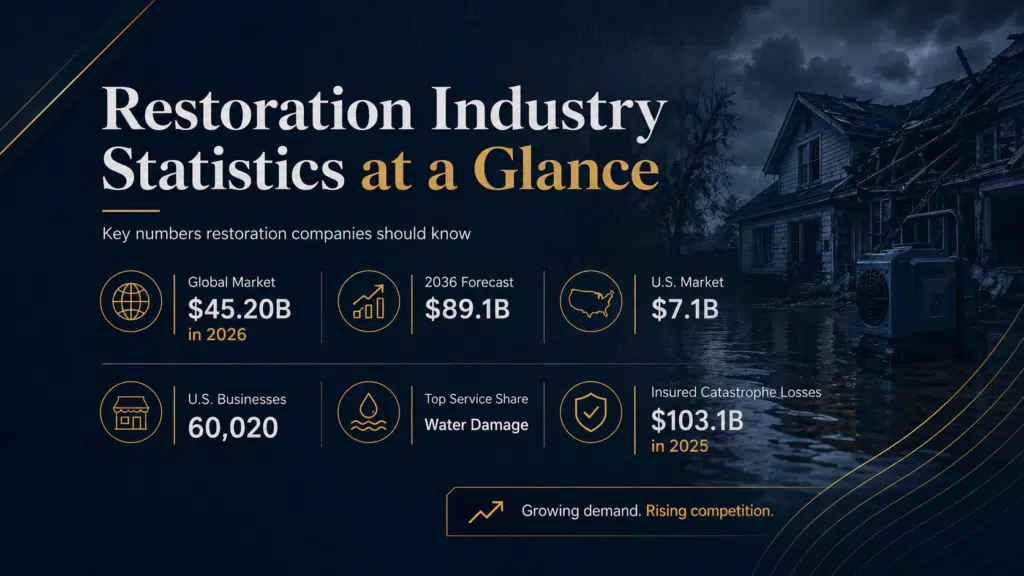
Here are the key numbers restoration companies should know before planning SEO, paid ads, local pages, reviews, or lead tracking.
| Area | 2026 or Latest Available Data | What It Means for Restoration Companies |
| Global disaster restoration market | Estimated at $45.20 billion in 2026 by Mordor Intelligence | Demand is large enough for local companies, franchises, and specialty providers to compete. |
| Long-term global forecast | Fact.MR estimates the market may reach $89.1 billion by 2036 | Restoration is not a short-term trend. The category is expected to keep growing. |
| U.S. damage restoration market | IBISWorld lists the U.S. market at $7.1 billion in 2026 | U.S. companies are competing in a large but local-intent market. |
| U.S. business count | IBISWorld reports 60,020 damage restoration businesses in the U.S. | Strong service is not enough. Visibility and trust signals matter. |
| Water damage share | Mordor reports water damage restoration led the disaster restoration market by service type in 2025, with a 38.56% share. | Water damage pages, local SEO, and emergency CTAs deserve priority. |
| U.S. insured catastrophe losses | The Insurance Information Institute lists $103.1 billion in insured property losses for U.S. natural catastrophes in 2025 | Storms, wildfire, flooding, and severe weather continue to support restoration demand. |
These numbers point to one practical takeaway: the market is growing, but so is competition. A restoration company cannot rely only on referrals, repeat customers, or a basic website. People search when the problem is urgent, and the companies that show up clearly are more likely to get the call.
How Big Is the Restoration Market in 2026?
The restoration market size depends on how the industry is measured. Some reports focus on disaster restoration services, while others include broader categories such as damage restoration, remediation, cleaning, reconstruction, fire cleanup, storm recovery, and water damage work.
Mordor Intelligence estimates the disaster restoration services market at $45.20 billion in 2026, with a forecast of $58.46 billion by 2031. Fact.MR estimates the market at $48.9 billion in 2026 and projects it to reach $89.1 billion by 2036. IBISWorld narrows the view to damage restoration services in the United States and lists the 2026 U.S. market size at $7.1 billion.
For a restoration business owner, the exact number is less important than the pattern. Multiple sources show growth. The reasons are clear enough: homes are aging, weather losses are expensive, insurance claims require documentation, and customers need help quickly when damage affects their property.
The better question is not only, “How big is the market?” The better question is, “Which parts of this market can our company actually win?” A local company should care about service demand in its city, search visibility for water damage and mold terms, review strength, phone answer rate, and whether marketing spend is turning into booked work.
U.S. Restoration Industry Statistics Restoration Companies Should Know
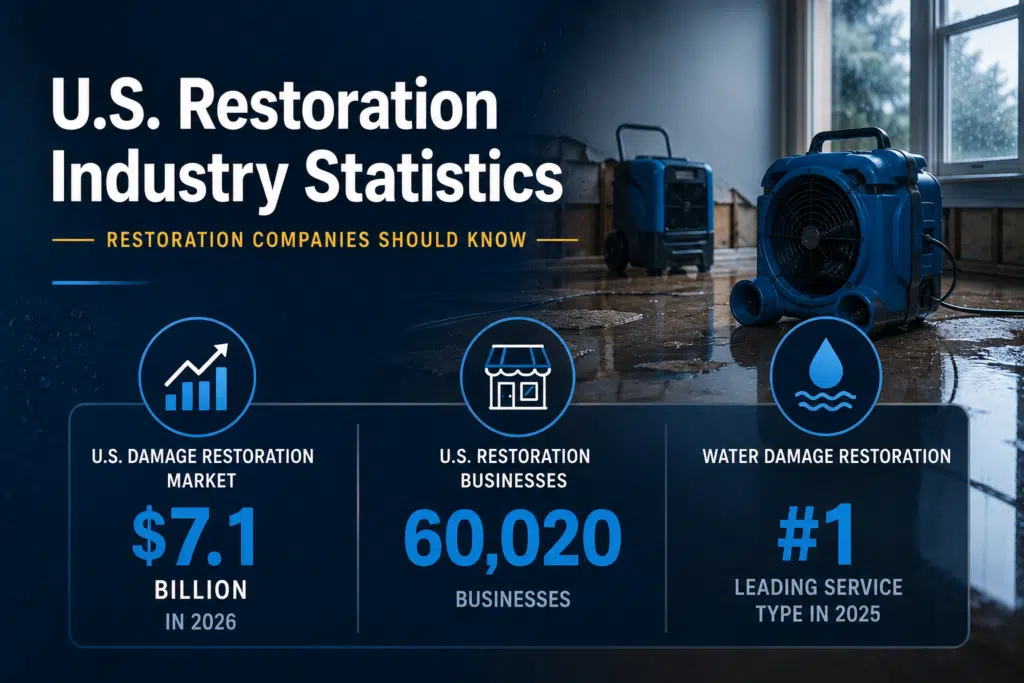
The U.S. restoration market is highly local, even when national brands and franchises are involved. A homeowner with standing water in a basement is not comparing a global market report. They are searching for a nearby company that can answer, explain the process, and show proof that it can handle the job.
IBISWorld reports that the U.S. damage restoration services industry is worth $7.1 billion in 2026. It also reports 60,020 businesses in the category. That count shows how crowded the market can feel at the local level. Many restoration companies offer similar services, including water extraction, structural drying, mold remediation, fire cleanup, storm damage repair, and contents cleaning.
This is where restoration marketing starts to matter. A company can have a skilled crew and still lose jobs if its website is thin, its Google Business Profile is weak, its reviews are outdated, or its ads are sending people to generic pages. That is why a strong restoration marketing strategy should be built around both demand and intent.
Water Damage Industry Data: Why Water Restoration Leads Demand
Water damage industry data deserves its own section because water is one of the most common reasons people need restoration help. It can come from burst pipes, appliance leaks, roof leaks, sewer backups, stormwater intrusion, broken supply lines, frozen plumbing, or flooding. It also creates urgency because waiting too long can lead to mold growth, material damage, odor, and higher repair costs.
Mordor Intelligence reports that water damage restoration led the disaster restoration market by service type in 2025, with a 38.56% share. That lines up with what many restoration companies see in real life. Water damage searches often come from homeowners and property managers who need immediate help, not casual research. They want to know what to do first, whether insurance may be involved, how drying works, and who can respond quickly.
This is why water damage pages should not be treated like basic service descriptions. A strong page should explain inspection, extraction, drying, moisture checks, documentation, timing, insurance support, and what the homeowner should avoid before help arrives. A helpful water damage restoration guide can support the customer before they are ready to speak with a company, while local service pages can turn urgent searches into phone calls.
Use the Data to Prioritize Better Restoration Leads
The numbers show where demand is growing. Build your pages, ads, and local SEO around the services people need most.
Fire, Smoke, Mold, and Storm Restoration Statistics Also Matter
Water damage may lead many restoration conversations, but fire, smoke, mold, and storm damage each create different types of demand. Fire and smoke jobs can be less frequent but more complex, often involving odor removal, soot cleanup, contents support, structural cleaning, and rebuild coordination.
Mold remediation demand is often connected to water damage, humidity, poor ventilation, roof leaks, plumbing problems, or delayed drying. Some mold searchers are ready to hire, while others are still trying to understand symptoms, inspection, testing, removal, and prevention.
Storm restoration demand can create sharp local spikes. A storm may trigger roof leaks, flooding, broken windows, exterior damage, and water intrusion across a service area. Companies that want this work need location relevance, updated Google Business Profile activity, strong reviews, service-specific content, and calls that are answered when demand rises.
The missed opportunity in many competitor articles is that they list service categories but do not explain what to do with them. In practice, each service should have its own keyword strategy, page structure, CTA, proof points, and tracking setup.
Disaster and Insurance Losses Are Driving Restoration Demand
Severe weather and natural catastrophes are a major reason restoration demand continues to show up in market reports. The Insurance Information Institute’s U.S. catastrophe data shows that insured property losses from U.S. natural catastrophes reached $103.1 billion in 2025. That number matters because many restoration jobs are tied to events where property damage, insurance documentation, cleanup, drying, repairs, and follow-up all need to happen quickly.
The Insurance Information Institute U.S. catastrophe data shows how severe weather, wildfire, flooding, and other property losses continue to create demand for restoration services.
For restoration companies, disaster losses are not just numbers in an insurance report. They affect real work after storms, wildfires, flooding, freezes, and severe weather. They also affect how customers behave. A homeowner dealing with damage is often stressed, unsure what insurance will cover, and trying to find a company that sounds reliable.
That is why trust-building content matters. Service pages should explain what happens after the first call, how documentation is handled, what the inspection includes, and how the company helps the customer understand the next step. This also connects to restoration industry trends 2026 because documentation, call handling, job communication, and customer education all shape whether a visitor trusts the company enough to call.
Restoration Industry Trends 2026: What Is Changing?
The most important restoration industry trends 2026 are not only about new tools or new equipment. They are about how restoration companies win trust before, during, and after the job.
| Trend | Why It Matters |
| Faster emergency response | Customers expect clear answers and next steps before they choose a company. |
| Better documentation | Insurance-related jobs often need photos, notes, readings, estimates, and clear records. |
| Smarter automation | Scheduling, follow-up, reporting, and reminders can reduce missed opportunities. |
| Higher pressure on lead quality | Limited crew capacity makes profitable leads more important than raw lead volume. |
| Stronger local search | Customers compare map results, reviews, photos, service pages, and recent activity. |
Many of the restoration industry trends that mattered in 2025 are still relevant in 2026, but the bar is higher now. Generic content and weak local pages are easier to ignore. Restoration companies need pages that answer real customer questions, prove local relevance, and guide visitors toward the next step without making the site feel like a hard sales pitch.
What These Statistics Mean for Restoration Marketing
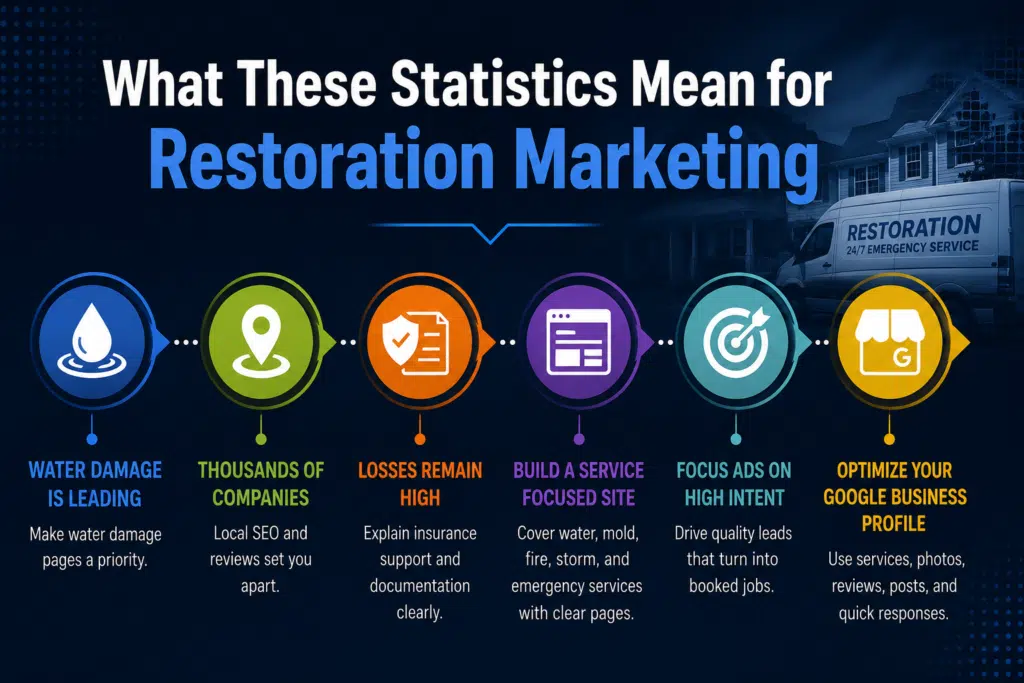
The most useful way to read restoration industry statistics is to connect them to action. If water damage is a leading service category, then water damage pages should be stronger. If the U.S. has thousands of restoration businesses, then local SEO and reviews matter. If insured losses remain high, then service pages should explain documentation and insurance support clearly.
A restoration company should build its marketing around service intent and local intent. That means pages for water damage restoration, mold remediation, fire damage restoration, storm damage restoration, and emergency restoration. It also means building local pages for the areas where the company can actually serve customers well.
Paid ads and Local Service Ads should focus on high-intent jobs instead of broad traffic. A campaign that brings cheap clicks but poor leads is not helping the business. The goal is booked work, not activity in an ad account. Google Business Profile should support the same plan with service categories, photos, reviews, business descriptions, posts, and response habits that make the company look active and trustworthy.
This is also where real proof matters. Restoration Inbound’s Pure Maintenance Arizona case study shows what can happen when the website and campaigns are built around actual lead generation. The company’s traffic increased by 471%, clicks per ad improved by 317%, and cost per click dropped by 34.11% after Restoration Inbound migrated the site, redesigned it, and launched a focused campaign.
A relevant client review says the same thing in a simpler way.
“Since we have implemented Restoration Inbound into our marketing strategy we have seen a SIGNIFICANT increase in not only calls but in overall ROI.”
Karina – Purified Environments
Turn Restoration Demand Into Booked Jobs
Industry growth only helps if your company shows up when customers are ready to call.
The Biggest Opportunity for Restoration Companies in 2026
The biggest opportunity in 2026 is not simply that the restoration market is growing. Growth does not automatically put more jobs on the calendar. More demand can also bring more competition, higher ad costs, stronger franchises, and more pressure on local companies to prove why they should be trusted.
The opportunity is to become more visible and more helpful at the exact moment customers are searching. That means clear service pages, local content, helpful guides, strong reviews, fast phone response, tracking, and honest proof. A restoration company does not need to rank for every broad industry term. It needs to show up for the services and cities that can produce profitable jobs.
The strongest companies will use restoration industry statistics to make better decisions. They will prioritize water damage if the data and their margins support it, build mold content if local demand exists, run paid campaigns where speed matters, and improve pages that already get impressions but do not convert.
Final Thoughts on Restoration Industry Statistics for 2026
The restoration industry is growing, but the story is bigger than market size. Water damage, mold, fire, smoke, storm damage, insurance claims, local competition, and customer search behavior all shape how restoration companies win work in 2026.
The most important takeaway from these restoration industry statistics is that demand alone is not enough. A company still needs to be found, trusted, and contacted. Restoration companies that use data to choose priority services, build better pages, improve local visibility, and track real leads will be in a stronger position than companies that only publish generic content or run ads without knowing what happened after the click.
FAQs About Restoration Industry Statistics
How big is the restoration industry in 2026?
The restoration market size depends on how the category is defined. Mordor Intelligence estimates the global disaster restoration services market at $45.20 billion in 2026, while Fact.MR estimates it at $48.9 billion. IBISWorld lists the U.S. damage restoration services market at $7.1 billion in 2026.
Is the restoration industry growing?
Yes. Demand is supported by water damage, storm damage, fire and smoke damage, mold issues, aging properties, insurance-related repair work, and severe weather events.
Why is water damage such a big part of the restoration industry?
Water damage is common, urgent, and often gets worse when it is not handled quickly. Leaks, floods, burst pipes, sewage backups, and stormwater can damage materials and increase the risk of mold.
What are the biggest restoration industry trends in 2026?
The biggest restoration industry trends 2026 include stronger local search competition, faster response expectations, better job documentation, more automation, more pressure to track lead quality, and continued demand from water, storm, mold, fire, and smoke-related damage.
What do these statistics mean for restoration companies?
They show that restoration companies need clear service pages, local SEO, reviews, paid campaigns where appropriate, fast call response, and tracking that connects marketing activity to booked jobs.
How can restoration companies use industry statistics in their marketing?
Restoration companies can use these numbers to choose priority services, target better locations, plan content, spend ad budget wisely, and track what actually produces qualified leads.