
Last Updated on June 8, 2026 by Hayk Saakian
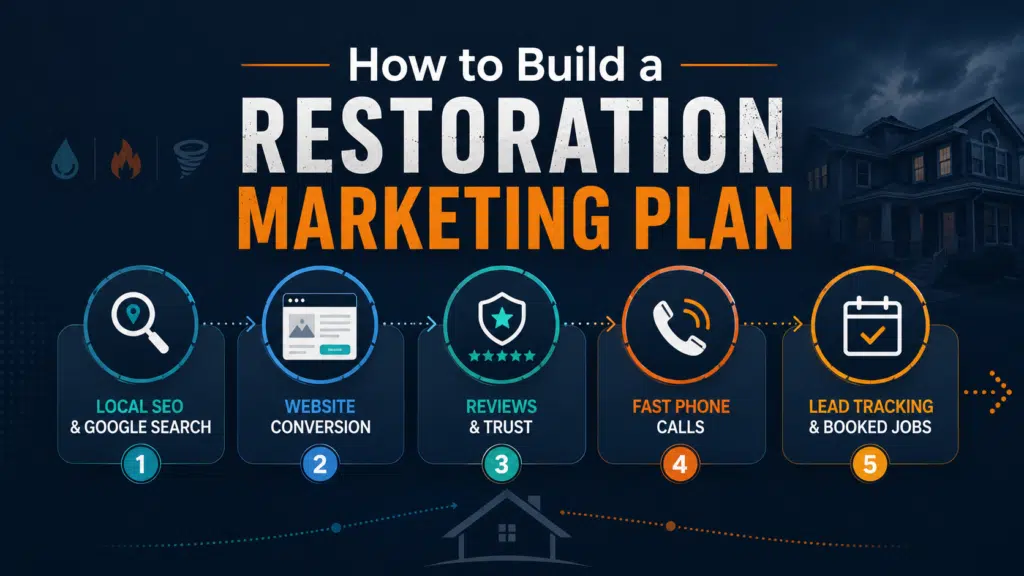
A restoration business does not grow just because it has a website, runs a few ads, or posts on social media when there is time. It grows when the right people find the company during a real problem, trust what they see, call quickly, and choose that company over every other option on Google. This is especially important for high-intent services such as water damage restoration marketing, where urgent searches, fast calls, and local trust can directly shape lead quality.
That is why a restoration marketing plan needs to be more practical than a list of marketing channels. It should show which services deserve attention, where the leads will come from, how the website will turn visitors into calls, how reviews and referrals will support trust, and how every lead will be tracked back to real jobs.
Restoration work is urgent, local, and often stressful for the customer. A homeowner dealing with water damage, mold, fire damage, or storm damage is not casually browsing for ideas. They need a company that looks credible, answers fast, and makes the next step simple.
What Is a Restoration Marketing Plan?
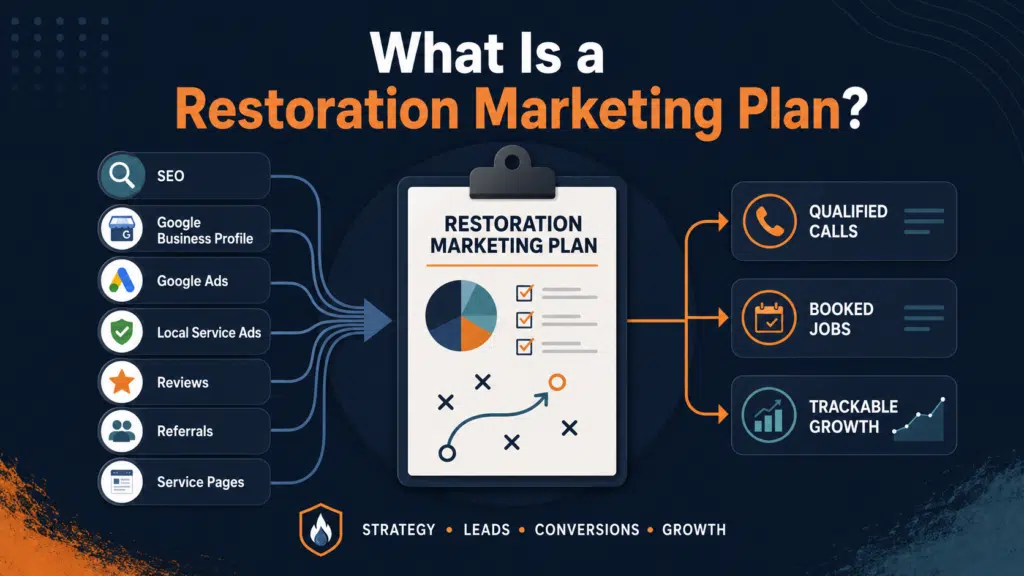
A restoration marketing plan is a written strategy that explains how a restoration company will attract, track, and convert leads from channels like SEO, Google Business Profile, Google Ads, Local Service Ads, reviews, referrals, and service-specific website pages.
The goal is not just more traffic. The goal is more qualified calls, better booked jobs, and a clearer view of which marketing channels are producing work that matters.
A strong restoration marketing plan should answer these questions:
| Planning Area | What You Need to Decide |
| Services | Which jobs are most valuable to promote? |
| Locations | Which cities or service areas matter most? |
| Channels | Where will leads come from? |
| Budget | How much can be spent to acquire a job? |
| Website | What pages and calls to action are needed? |
| Tracking | How will calls, forms, and booked jobs be measured? |
| Growth | What should improve in the next 30, 60, and 90 days? |
This is where many restoration companies lose control of their marketing. They run ads without call tracking, publish content without a service-page strategy, or depend too much on referrals without building a steady online lead source.
Why Restoration Marketing Needs a Different Strategy
Restoration company marketing is different from general home service marketing because the customer’s need is often urgent. A person searching for water damage restoration near me may be dealing with a wet basement, ceiling leak, burst pipe, or soaked flooring. They are not reading five long sales pages before making a decision. They are looking for proof that the company can help quickly.
That changes the whole strategy.
Your website needs a phone number above the fold. Your Google Business Profile needs strong reviews and accurate service areas. Your ads need to match the exact service someone searched for. Your landing pages need to remove doubt fast.
This is also why restoration digital marketing should not use the same message for every service. Water damage, mold remediation, fire damage, storm damage, sewage cleanup, and reconstruction all have different levels of urgency, customer questions, and conversion paths.
Water damage leads often need fast response and emergency messaging. Mold leads may need more education, trust, inspection details, and proof that the company understands the health and property concerns involved.
Set Your Goals, Budget, and Priority Services First
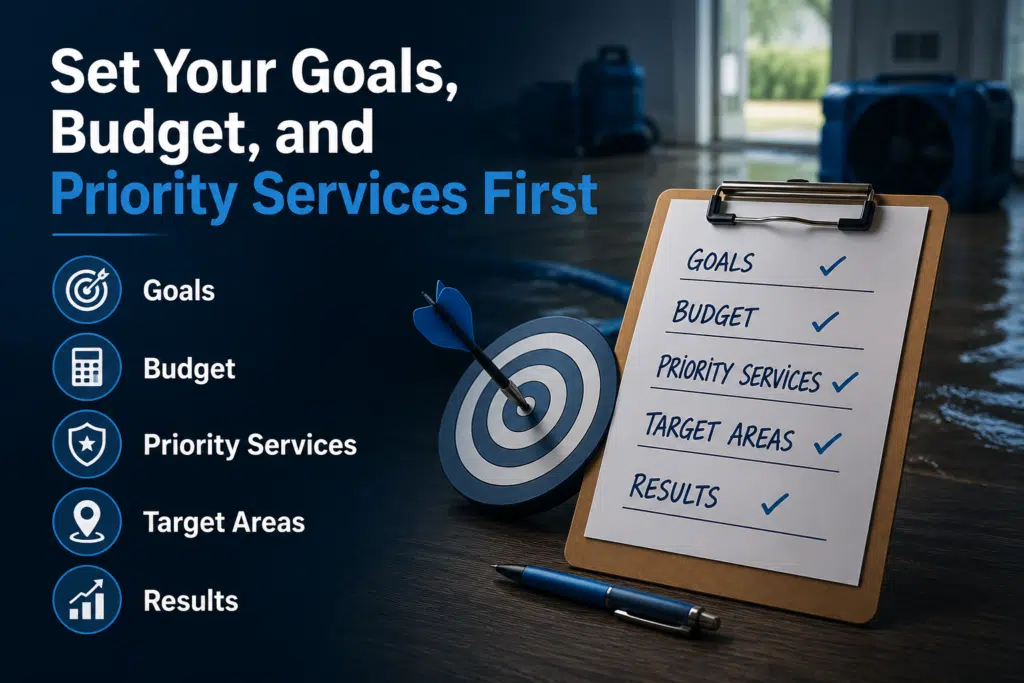
Before choosing channels, start with the business goal. Your restoration marketing plan should begin with numbers that make sense for the company.
Ask:
- How many qualified leads do we need each month?
- How many booked jobs do we need from those leads?
- What is our average job value?
- What is our close rate from qualified lead to booked job?
- Which services are most profitable?
- Which service areas are worth targeting first?
- How much can we spend to acquire a customer?
Here is a simple example. If a restoration company wants 20 booked jobs per month and closes 40% of qualified leads, it needs around 50 qualified leads per month. That number should guide the SEO plan, ad budget, review goals, referral outreach, and reporting.
The next step is choosing which services deserve the most attention. Not every service should get the same budget or content depth.
High-priority services often include:
- Water damage restoration
- Mold remediation
- Fire damage restoration
- Storm damage restoration
- Sewage cleanup
- Commercial restoration
- Reconstruction
- Contents cleaning or packout services
If water damage is one of your top services, build a separate plan around water damage restoration marketing. If mold is a major service line, your content, reviews, ads, and local SEO should also support mold remediation marketing.
A plan works better when each service has its own path instead of being buried inside one generic services page.
Build Your Local SEO and Google Maps Foundation
Local SEO is one of the strongest long-term channels for restoration companies because it helps capture high-intent searches in the cities you serve. When someone needs emergency help, they usually search on Google, check the map results, scan reviews, and call a company that looks reliable.
That makes Google Business Profile a real lead channel, not just a business listing.
Your local SEO foundation should include:
- A complete Google Business Profile
- Accurate business name, address, phone number, and website
- Correct primary and secondary categories
- Clear service areas
- Regular photo updates
- Before-and-after project images where appropriate
- Review requests after completed jobs
- Review responses
- Local citations
- Service-specific website pages
- City or service-area pages where they make sense
- Internal links between related pages
- Basic schema markup
- Fast mobile page experience
If the company is serious about restoration SEO, the website should not depend on one broad page. It should have clear pages for water damage restoration, mold remediation, fire damage restoration, storm damage, sewage cleanup, commercial restoration, and other important services.
The same applies to locations. If the business serves multiple cities, the site should explain where it works and what it offers in each priority area. Thin location pages will not help much. Useful local pages should include service details, local proof, FAQs, reviews, project examples if available, and clear next steps.
For 2026, this also matters for AI Overviews and LLM visibility. Google’s own guidance on AI features in Search makes it clear that helpful content, crawlable text, page experience, and standard SEO practices still matter. That means the best content is not written only for rankings. It is written to answer real questions clearly enough for customers, search engines, and AI systems to understand.
Use Google Ads and LSAs for Faster Emergency Leads
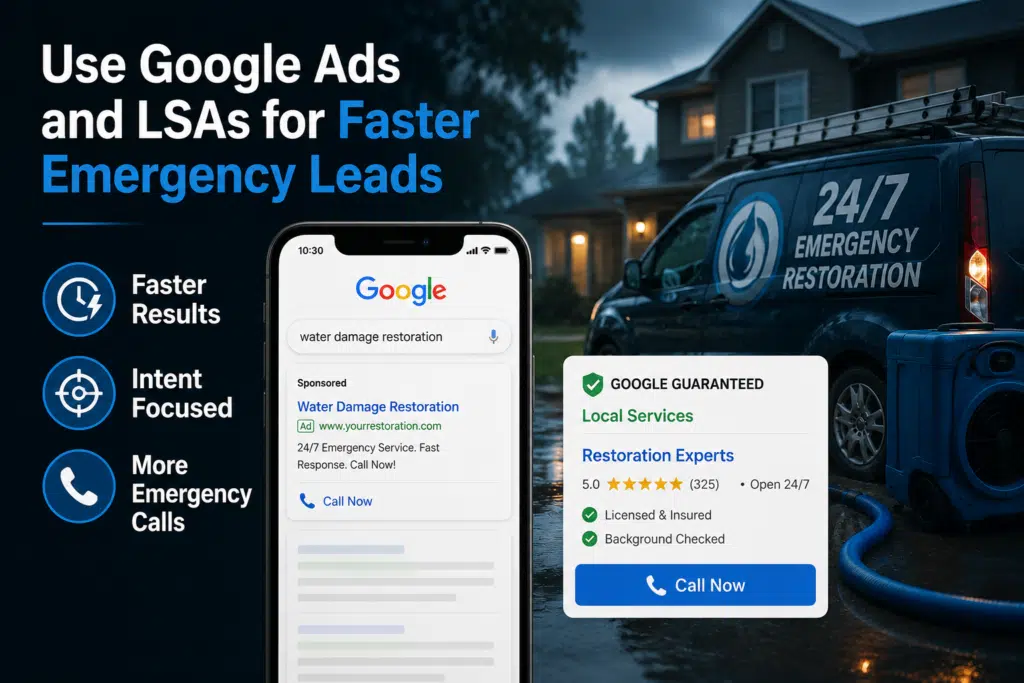
SEO can build a strong base, but restoration companies often need leads faster than SEO can deliver. That is where Google Ads and Local Service Ads can help when they are set up with discipline.
Paid ads should not be built around broad traffic. They should be built around intent.
| Campaign Type | Best Use |
| Search Ads | Capturing high-intent service searches |
| Local Service Ads | Getting local calls from verified listings |
| Call campaigns | Driving phone calls for urgent jobs |
| Service landing pages | Matching ad copy to the exact service |
| Negative keywords | Reducing waste from poor-fit searches |
| Call tracking | Measuring which campaigns produce real leads |
One common mistake is sending every paid click to the homepage. That creates a mismatch. A person searching for mold remediation should land on a mold page. A person searching for emergency water cleanup should land on a water damage page. A commercial restoration search should not be treated the same as a homeowner emergency search.
This is one of the clearest areas where restoration digital marketing can improve quickly. Better ad structure, stronger landing pages, and clean call tracking can make the difference between paying for clicks and understanding which campaigns are producing real opportunities.
Case Study: Pure Maintenance Arizona
Pure Maintenance Arizona is a good example of why a restoration marketing plan needs more than basic visibility. Before working with Restoration Inbound, the company had little online presence and was relying heavily on word of mouth. Restoration Inbound helped rebuild the website foundation and launched targeted Google Ads campaigns to bring in more calls and form submissions. According to the Pure Maintenance Arizona case study, their monthly jobs increased from 0 to 25, website traffic increased by 471%, clicks per ad improved by 317%, and cost per click was reduced by 34.11%.
The lesson is simple: restoration marketing works better when the website, paid ads, tracking, and service intent are connected. Traffic by itself is not the goal. The goal is to turn the right searches into calls, forms, and booked restoration jobs.
Want a plan that connects SEO, ads, and calls instead of treating them separately?
Improve Your Website So More Visitors Become Calls
A website should not just explain what the company does. It should help a stressed customer take action with confidence.
For restoration companies, the most important website job is usually simple: make the right visitor call, request help, or submit a short form.
That means the page needs to remove confusion quickly.
Your restoration website should include:
- Phone number near the top of every page
- Mobile click-to-call button
- Clear 24/7 emergency messaging if the company offers it
- Short contact forms
- Service area information
- Reviews and testimonials
- Certifications or industry memberships if applicable
- Insurance help messaging if accurate
- Before-and-after photos where appropriate
- Clear service cards
- Fast-loading pages
- Strong internal links to important services
If the website hides the phone number, uses weak calls to action, loads slowly on mobile, or sends every visitor through a long form, it will lose leads that could have turned into jobs.
This is why restoration lead generation should include website conversion work, not just traffic generation. More traffic will not fix a page that does not build trust or make contacting the company easy.
| Website Element | Why It Matters |
| Phone number above the fold | Makes urgent calls easier |
| Short form | Reduces friction |
| Service-specific headline | Matches the visitor’s problem |
| Reviews near CTAs | Builds trust before action |
| Service area proof | Confirms the company can help locally |
| Sticky mobile call button | Helps mobile users act quickly |
| Fast page speed | Reduces drop-offs |
| Clear next step | Removes decision confusion |
The website does not need to be flashy. It needs to be clear, fast, trustworthy, and focused on the services customers actually search for.
Build a Review and Referral System
Reviews and referrals should not be left to chance. In restoration, trust is a major part of the sale because customers are often dealing with property damage, insurance questions, and urgent decisions.
A review system should be simple:
- Ask satisfied customers for a Google review
- Send the review link by text or email
- Respond to reviews professionally
- Add strong reviews to relevant service pages
- Use service-specific review language where natural
- Track review growth each month
A referral system should also be intentional. Restoration companies can build relationships with plumbers, HVAC companies, roofers, property managers, realtors, insurance contacts, apartment managers, and commercial facility managers.
This matters because not every good lead comes from Google. Some of the best leads come from people who are already trusted by the property owner.
Restoration Inbound’s own reviews reflect this point well.
“They’re getting us out of the office and into people’s homes.”
Jesse – Alpha Restoration
That is the kind of outcome a marketing plan should support: not vanity numbers, but real conversations with real prospects.
The best restoration company marketing plans combine online demand with human trust. SEO, ads, and website pages can create visibility. Reviews and referrals help people feel comfortable choosing the company.
Track Calls, Leads, Jobs, and ROI

A restoration marketing plan is incomplete without tracking. If you do not know which channels are creating qualified leads, it becomes easy to waste money on campaigns that look active but do not produce booked jobs.
Tracking should go beyond form submissions.
Restoration companies should track:
- Phone calls
- Contact form submissions
- Google Business Profile calls
- Organic leads
- Paid ad leads
- Local Service Ad leads
- Missed calls
- Qualified leads
- Booked jobs
- Cost per lead
- Cost per booked job
- Close rate
- Average job value
- Revenue by channel
This is where many campaigns get messy. A company may see more clicks or more traffic, but if calls are missed or the wrong leads are coming in, the business still feels stuck.
The better question is not “How much traffic did we get?” The better question is “Which channel produced jobs we actually wanted?”
Monthly reporting should be simple enough for an owner to understand. It should show what improved, what did not, which services are producing leads, where the best calls are coming from, and what should change next month.
Need help turning website traffic into tracked calls and booked restoration jobs?
30, 60, and 90-Day Restoration Marketing Plan
A good plan should give the company a clear first step, not a vague list of ideas. Here is a practical 90-day structure.
| Timeline | Main Focus | What to Do |
| First 30 days | Fix the foundation | Audit the website, set up call tracking, review service pages, optimize Google Business Profile, improve phone visibility, check forms, collect missing reviews, and identify top service areas. |
| Days 31 to 60 | Build lead channels | Launch or improve Google Ads, create service-specific landing pages, improve local citations, publish helpful content, add internal links, and start referral outreach. |
| Days 61 to 90 | Improve and scale | Review lead quality, remove wasted ad spend, improve landing pages, expand high-performing services, build more reviews, and adjust budget based on booked jobs. |
This is not a one-time setup. The first 90 days should create structure, but the plan should be reviewed every month.
Some months may require more PPC because emergency lead volume is needed quickly. Other months may focus more on SEO, reviews, local pages, or referral partners. The best plan changes based on what the data shows.
Common Restoration Marketing Mistakes to Avoid
A lot of restoration marketing problems come from weak structure, not lack of effort. Companies may be spending money, posting content, running ads, and still not know what is actually working.
Avoid these common mistakes:
- Running ads without call tracking
- Sending every ad click to the homepage
- Ignoring Google Business Profile
- Using one page for every restoration service
- Creating generic blog content with no service intent
- Not asking customers for reviews
- Not responding to reviews
- Having slow mobile pages
- Using long forms for urgent leads
- Not tracking missed calls
- Measuring leads but not booked jobs
- Treating water, mold, fire, and storm leads the same
- Ignoring referral partners
- Expanding service areas before the core market is strong
The biggest mistake is treating every lead the same. A homeowner with standing water, a landlord dealing with mold complaints, and a property manager looking for commercial restoration support may all need restoration services, but they are not making the same decision in the same way.
That is why learning how to market a restoration company starts with understanding the customer’s situation. The channel matters, but the intent behind the lead matters more.
FAQs About Restoration Marketing Plans
What is a restoration marketing plan?
It is a strategy that shows how a restoration company will get more qualified leads and booked jobs through SEO, Google Business Profile, paid ads, referrals, reviews, website improvements, and lead tracking. It should connect marketing activity to real business outcomes.
How do I market a restoration company in 2026?
To market a restoration company in 2026, focus on local SEO, Google Business Profile, service-specific pages, Google Ads, Local Service Ads, reviews, referral partners, fast website conversion, and call tracking. The content should also be clear enough for search engines, AI Overviews, and customers to understand.
What is the best marketing channel for restoration companies?
The best channel depends on the company’s goals, but SEO, Google Maps, Google Ads, Local Service Ads, and referrals are usually the most important. These channels help restoration companies reach people who are actively looking for water damage, mold, fire, storm, or emergency restoration help.
Does SEO work for restoration companies?
Yes, SEO can work well for restoration companies when it is built around local intent, service pages, Google Business Profile, reviews, internal links, and strong website structure. It is especially useful for searches related to water damage restoration, mold remediation, fire damage restoration, and emergency restoration services.
Should restoration companies use Google Ads?
Restoration companies should consider Google Ads when they need faster lead flow, especially for urgent services like water damage, mold, fire damage, and storm damage. Ads work better when campaigns are separated by service, calls are tracked, and traffic is sent to focused landing pages.