
Last Updated on May 13, 2026 by Hayk Saakian
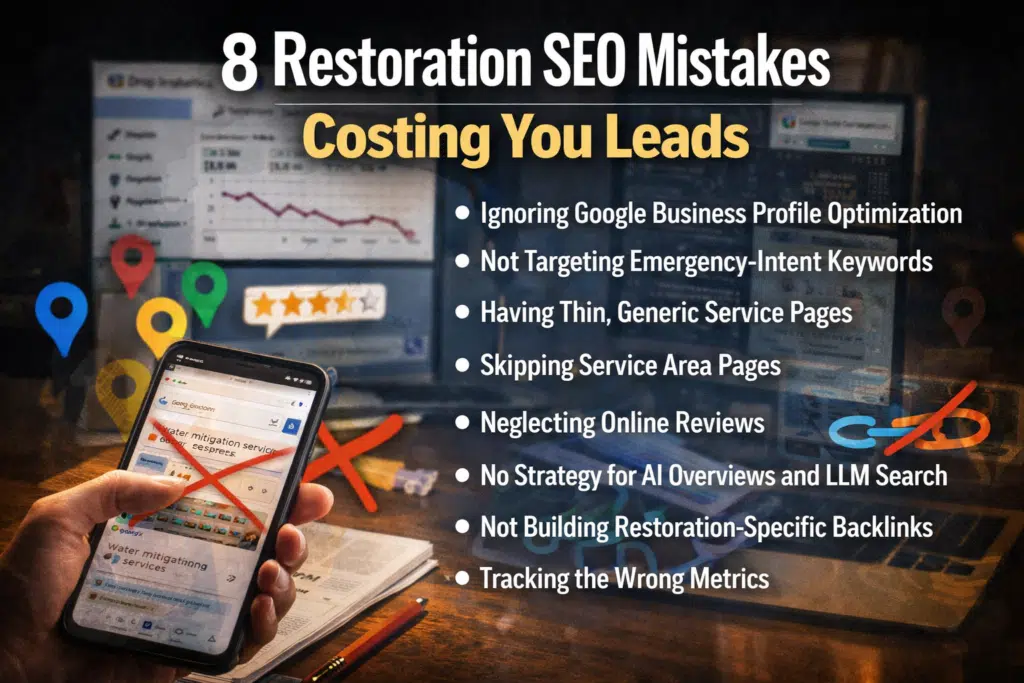
Restoration SEO mistakes are errors in local SEO, content structure, Google Business Profile optimization, and keyword targeting that prevent restoration companies from ranking on Google and generating consistent leads.
Most restoration companies invest in SEO but still struggle to show up when homeowners search for help. The reason is simple: common restoration SEO mistakes silently kill your rankings, drain your budget, and send leads straight to competitors.
We have worked with dozens of restoration companies, and the same patterns keep showing up. Most restoration company SEO tips you find online focus on what to do, but rarely cover what to stop doing, which is just as important.
Businesses spend more money on SEO for restoration companies without seeing real results, not because SEO doesn’t work, but because a few critical errors are holding everything back.
This guide covers the most damaging restoration SEO mistakes we see in 2026:
- Ignoring Google Business Profile Optimization
- Not Targeting Emergency-Intent Keywords
- Having Thin, Generic Service Pages
- Skipping Service Area Pages
- Neglecting Online Reviews
- No Strategy for AI Overviews and LLM Search
- Not Building Restoration-Specific Backlinks
- Tracking the Wrong Metrics
1. Ignoring Google Business Profile Optimization
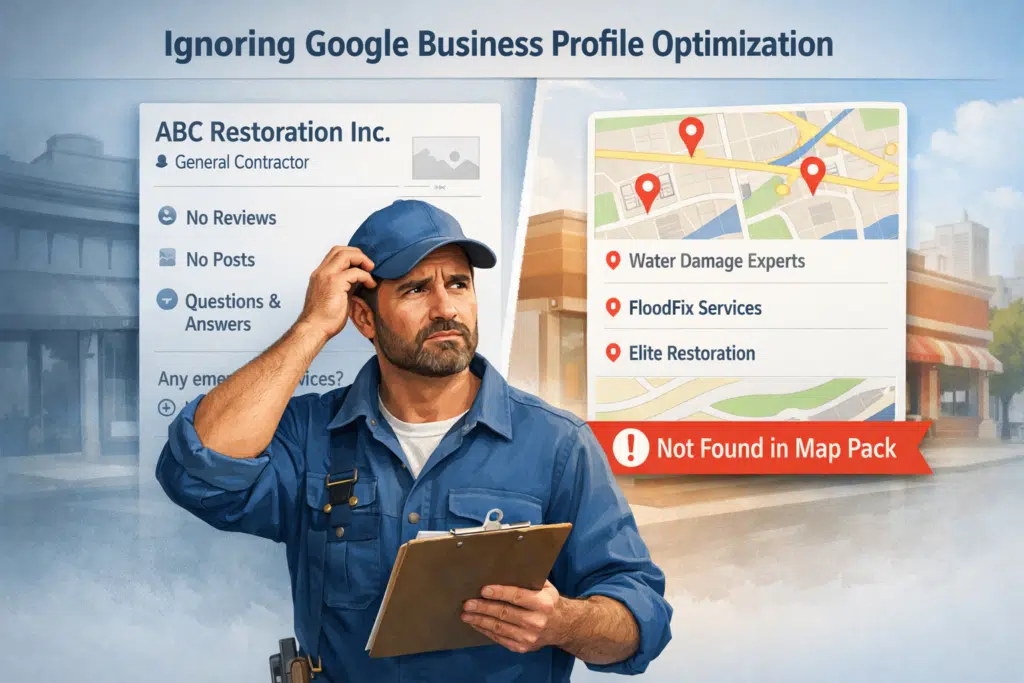
Your Google Business Profile is where most customers decide whether to call you or not. Over 60% of local searches end without anyone clicking through to a website, which means if your GBP listing is incomplete, you’re losing jobs before people even see your site.
Nearly 46% of all Google searches have local intent, which means showing up in Google Business Profile results is often more important than your website itself.
And yet, so many restoration companies get the basics wrong:
- Listing the primary category as “General Contractor” instead of “Water Damage Restoration Service”
- Forgetting secondary categories like “Fire Damage Restoration Service” or “Mold Remediation Service”
- Not turning on emergency service attributes like “24/7 availability”
- Zero before-and-after project photos
- Never posting updates or responding to the Q&A section
Think of your GBP like a storefront window. If it looks empty and outdated, people walk right past. In 2026, your profile deserves the same effort as your homepage because honestly, for a lot of customers, it is your homepage.
We hear this from restoration business owners all the time. Jessica Walley, Vice President of Operations at Remove the Mold, put it this way:
“I knew that we needed more of an online presence, but how do you do that? What I really appreciate about these guys is their thoughtfulness and expertise, knowing the why not just the how to.”
For most companies, that journey starts with getting your Google Business Profile right. Our guide on optimizing your Google Business Profile for restoration businesses walks you through the full process.
2. Not Targeting Emergency-Intent Keywords
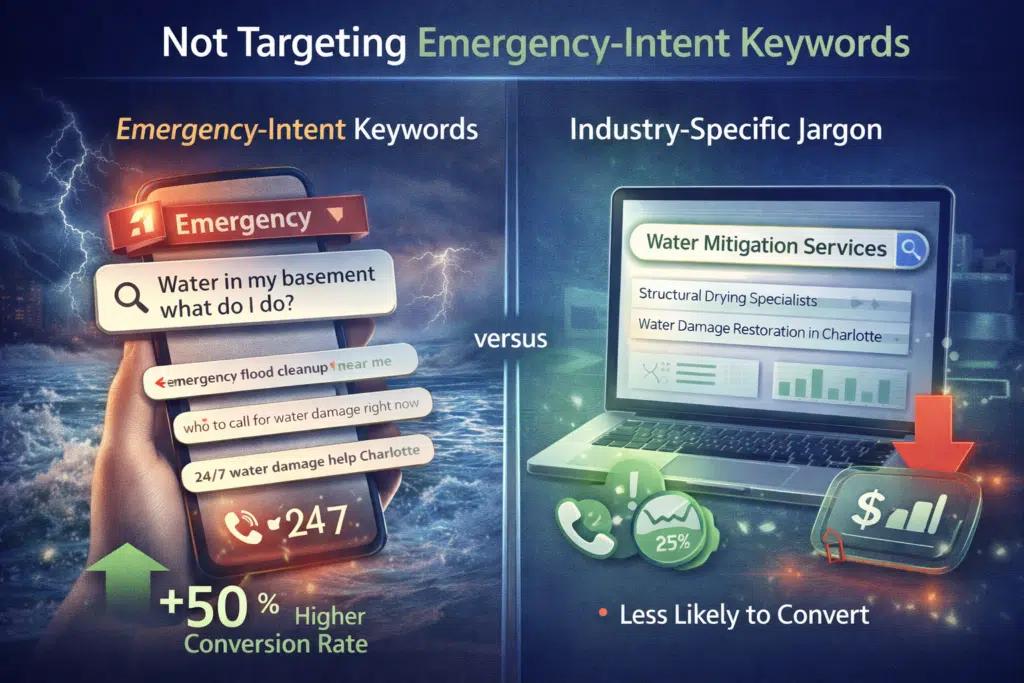
Here is something we notice with almost every restoration company we audit. The website is optimized for terms like “water mitigation services” or “structural drying specialists,” which sound great on paper. But real homeowners dealing with a flooded basement at 2 AM are not searching like that.
They are typing things like:
- “water in my basement what do I do”
- “emergency flood cleanup near me”
- “who to call for water damage right now”
- “24/7 water damage help [city]”
These emergency-intent keywords convert roughly 50% higher than generic service terms because the person behind the search is panicking and ready to call the first company they find. Optimizing for industry jargon instead of real human language is one of the biggest water damage SEO mistakes we see, and one of the most common restoration SEO mistakes that costs companies leads every single day.
Try this as a quick test.
Pull up your top service pages and read the headings out loud. Do they sound like something a stressed homeowner would actually type into their phone at midnight? If the answer is no, those pages need work.
3. Having Thin, Generic Service Pages
You built a nice looking website, added an “Our Services” page with a short paragraph about water damage, fire damage, and mold removal, and figured that was enough. Unfortunately, Google does not see it that way. One page trying to cover everything will rank for nothing because search engines need depth and specificity to understand what you actually do.
If you have ever wondered why my restoration website doesn’t rank despite having a decent-looking site, this is one of the most damaging restoration SEO mistakes we come across during audits.
Every core service needs its own dedicated page. Your water damage restoration marketing page should live completely separate from fire damage, which should be separate from mold remediation. Each page needs to answer the questions homeowners are actually asking:
- What does the restoration process look like step by step
- How long will it take
- Do you work directly with insurance companies
- What should the homeowner do before you arrive
- What certifications does your team hold, such as IICRC certifications?
In 2026, Google rewards pages that demonstrate real experience and expertise through what they call E-E-A-T. Thin pages get buried. Pages that genuinely help people are the ones that rank and convert.
We have seen this play out with our own clients. When Purified Environments overhauled their website content and marketing strategy, the results spoke for themselves. Karina from their team shared,
“Since we have implemented Restoration Inbound into our marketing strategy we have seen a SIGNIFICANT increase in not only calls but in overall ROI. The revenue in 2023 has almost surpassed the revenue in ALL of 2022.”
That kind of growth starts with giving Google and your customers real content to work with instead of thin pages that say nothing.
Struggling to generate leads from your website? We’ll uncover what’s limiting its performance and highlight the key areas that need improvement.
4. Skipping Service Area Pages
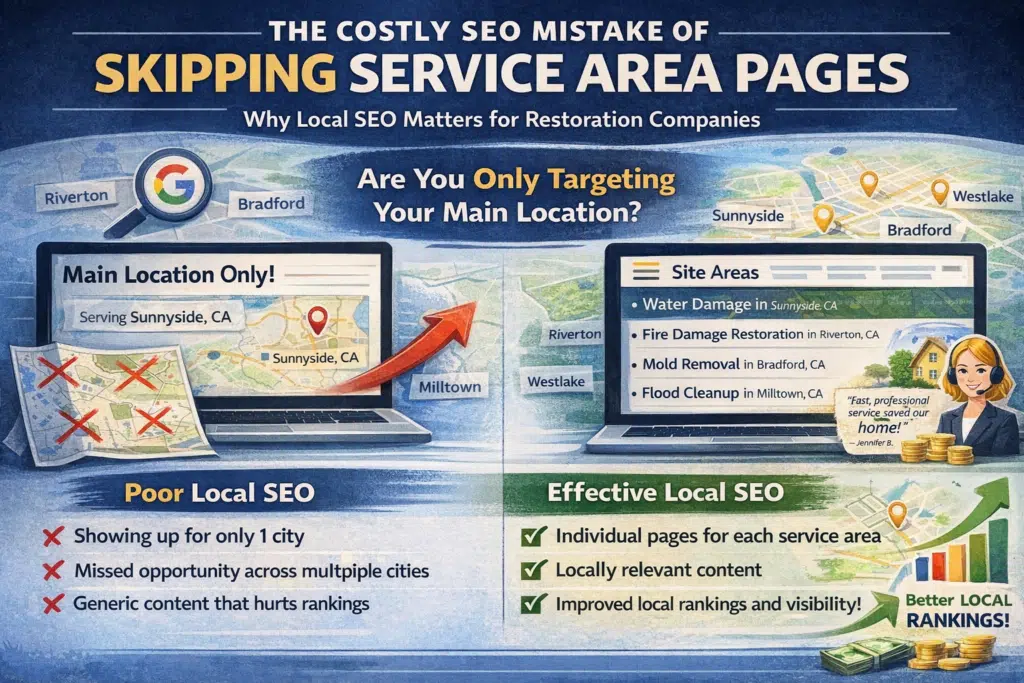
Most restoration companies serve multiple cities but only mention their main location on the homepage. That is a huge missed opportunity. If you serve 15 cities but your website only references one, Google has no reason to show you in search results for the other 14.
Each service area needs its own page with unique, locally relevant content. Not just the same paragraph copied across 15 pages with the city name swapped out. Google is smart enough to recognize duplicate content, and it will ignore those pages entirely.
A strong service area page should include:
- Your specific services available in that city
- References to local landmarks, neighborhoods, or common property types
- A unique description of the kinds of jobs you handle in that area
- An embedded Google Map for that location
- Testimonials from customers in that specific market if you have them
This is one of the most overlooked restoration SEO mistakes and one of the biggest local SEO mistakes restoration companies make, especially those growing into new territories. You might be doing great work in those cities, but if Google doesn’t know you serve them, homeowners there will never find you.
5. Neglecting Online Reviews as an SEO Signal
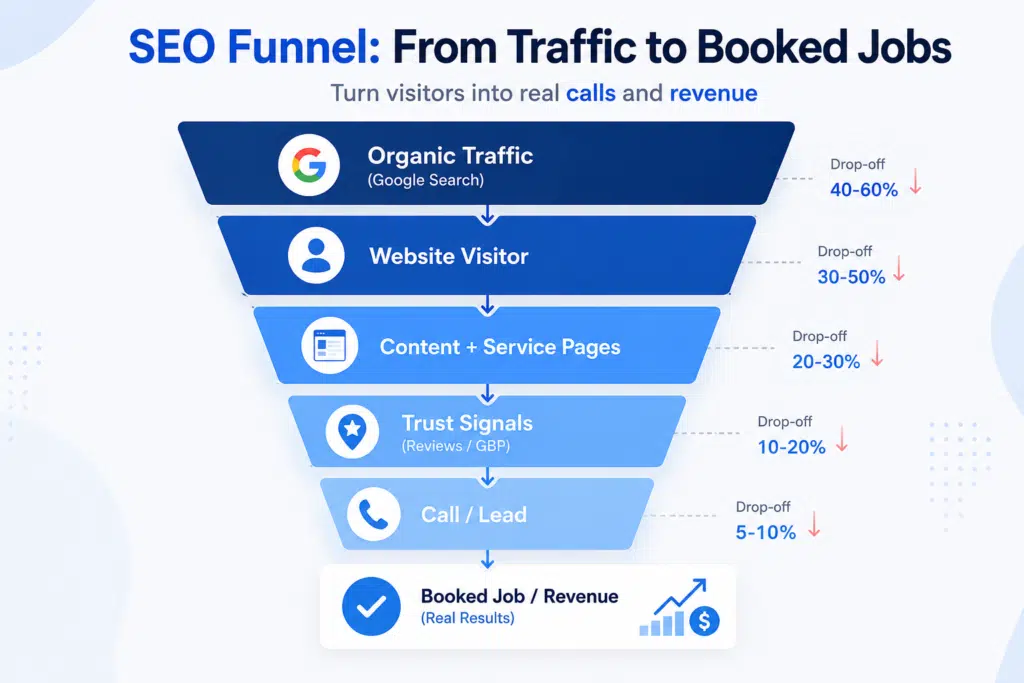
One of the less obvious restoration SEO mistakes involves online reviews, which are not just about reputation. They directly influence where your business shows up in Google’s local pack. Google pays more attention to review velocity, how frequently new reviews come in, than your total review count. A company with 40 reviews that gets two new ones every week will outperform one with 200 reviews that hasn’t gotten a new one in six months.
When customers mention specific services like “fast water damage cleanup” or “handled our mold removal professionally,” those keywords reinforce your local SEO relevance. You can guide this by asking customers to mention the specific service you provided when they leave their review.
Daniel Clay, owner of Pure Air Charlotte, saw what happens when these fundamentals come together: “It used to be a constant struggle to get leads when we were just starting out. Now we’ve solidified our company and are constantly growing as we have generated 3 to 5 qualified leads weekly for the last year.”
Build a post-job review request system, send a text or email within 24 hours of every completed job, and respond to every review you receive because Google tracks that too.
6. No Strategy for AI Overviews and LLM Search

If you have not noticed, Google looks very different in 2026 than it did even two years ago. More than half of all search results now start with an AI-generated answer sitting right at the top of the page. Google calls these AI Overviews, and they pull content directly from websites that are structured in a way the AI can easily read and summarize.
In fact, nearly 60% of Google searches now end without a click, which means if your content is not being picked up in AI answers, you may not get traffic at all.
But it is not just Google anymore. Homeowners are asking ChatGPT and Perplexity things like “what should I do about water damage” or “how do I find a good mold removal company.” If your website content is not showing up in those answers, you are missing an entirely new way people find restoration companies.
Most restoration companies have not even started thinking about this, which means restoration website optimization in 2026 is no longer just about keywords and backlinks. Here is what actually works for getting your content picked up by AI:
- Write your headings as questions that real people would ask
- Give a straight answer in the first sentence or two right under the heading
- Keep your paragraphs short and scannable
- Break up information with bullet points whenever it makes sense
- Add an FAQ section to your most important pages
If your restoration SEO strategy does not account for how AI search works, ignoring it is quickly becoming one of the costliest restoration SEO mistakes a company can make.
7. Not Building Restoration-Specific Backlinks
When it comes to restoration SEO mistakes that happen off your website, weak backlink strategy is at the top of the list. Backlinks are still one of Google’s strongest ranking signals in 2026, but here is where most restoration companies get it wrong. They either ignore link building entirely, or their SEO agency is getting them links from random directories that have nothing to do with restoration.
Google cares about relevance.
A link from the Restoration Industry Association carries far more weight than a link from some generic blog nobody reads. A restoration company with 15 high-quality, industry-relevant links will almost always outrank one sitting on 100 random low-quality ones.
Here are backlink sources that most restoration companies never think about but absolutely should:
- RIA (Restoration Industry Association) member listing
- IICRC member directory listing
- BBB accredited business profile
- Local chamber of commerce website
- Insurance company preferred vendor directories
- Partner websites from plumbers, roofers, and property managers you already work with
That last one is gold.
If a plumber regularly sends you referrals, ask them to link to your website from their recommended vendors page. It costs nothing, Google loves it because the relationship is real, and it strengthens a partnership you have already built.
Most restoration SEO mistakes happen on the website itself, but ignoring off-site authority building is just as damaging to your long-term rankings.
8. Tracking the Wrong Metrics
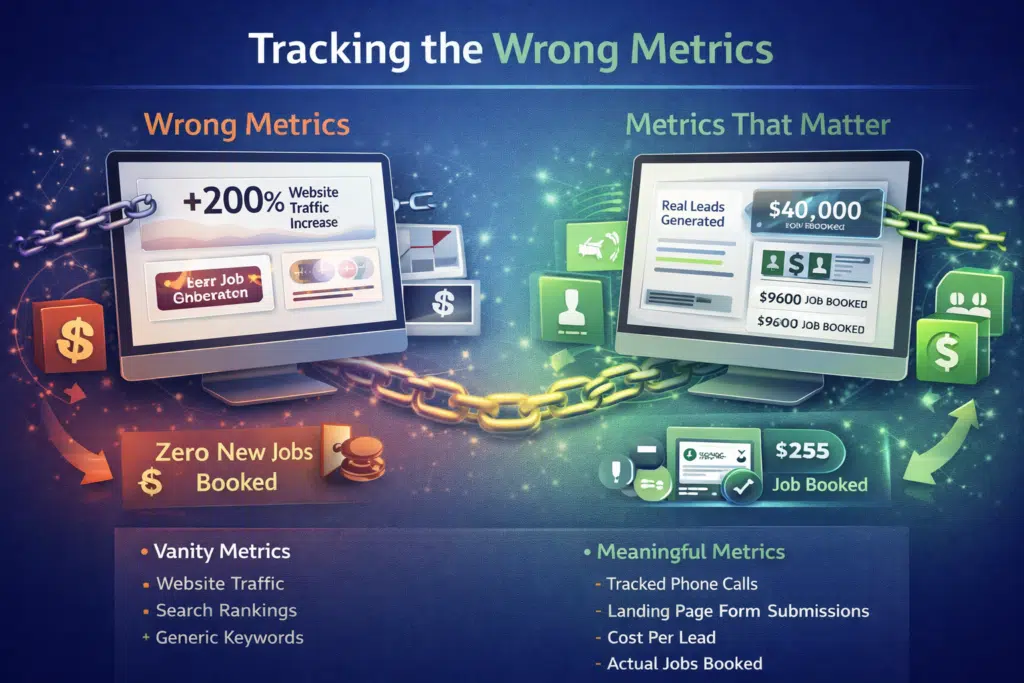
This is the restoration SEO mistake that lets every other problem on this list go undetected. Too many restoration companies log into their SEO dashboard, see that traffic went up or rankings improved, and assume everything is working. But traffic and rankings do not pay your bills. Phone calls and booked jobs do.
We have seen companies celebrate a 200% increase in website traffic while their actual lead volume stayed completely flat. That usually means the traffic is coming from irrelevant keywords or pages that have no clear way for someone to contact you.
The metrics that actually matter for a restoration company are:
- Phone calls tracked by source so you know which pages generate real inquiries
- Form submissions tied to specific landing pages
- Cost per lead so you can compare SEO against other channels like PPC or LSAs
- Booked jobs attributed back to organic search
If your SEO provider cannot tell you how many actual jobs their work generated, that is a problem. Good restoration lead generation is always measured by revenue, not vanity metrics.
That is exactly how we approached our work with EnviroPure, a mold removal company in Virginia. We tracked everything through CallRail and form submissions. The campaign hit 128% of the agreed KPI goals, and they closed a single project worth $40,000. That kind of clarity only comes when you measure what actually matters.
Every mistake on this list is fixable. At Restoration Inbound, we work exclusively with restoration companies and we know exactly where to look.
FAQs About Restoration SEO Mistakes
1. Why is my restoration company not showing up on Google?
Nine times out of ten, it comes down to a few things happening at the same time. Your Google Business Profile might be missing key information, your service pages probably lack the depth Google needs to rank them, and you might not have enough recent reviews to compete in the local pack. On top of that, missing service area pages and inconsistent business information across online directories can quietly hold you back. Start with a full audit of your GBP and go from there.
2. How long does SEO take to work for a restoration company?
Honestly, it depends on where you are starting from. Most companies start seeing real movement within three to six months of consistent work. Some things move faster, like fixing up your Google Business Profile or improving your site speed, where you might notice a difference in a few weeks. But ranking for competitive service keywords in your area takes longer because you are building trust and authority with Google over time, not just flipping a switch.
3. What keywords should a restoration company target?
Forget the technical jargon. Focus on the words real homeowners use when something goes wrong. Things like “emergency water damage repair near me,” “mold removal in [city],” or “who to call for fire damage” will always outperform industry terms like “water mitigation” or “structural drying.” Your best bet is a mix of service-specific, location-specific, and urgency-driven keywords spread naturally across your site.
4. What is the biggest SEO mistake restoration companies make in 2026?
Not adapting to how search actually works right now. Google’s AI Overviews, ChatGPT, and other AI tools are changing the way homeowners find and choose restoration companies. If your website is still built the old way with walls of text, no clear structure, and no direct answers to common questions, you are falling behind. The companies that are growing right now are the ones combining solid local SEO with content that AI systems can actually read, understand, and recommend.