
Last Updated on May 22, 2026 by Hayk Saakian
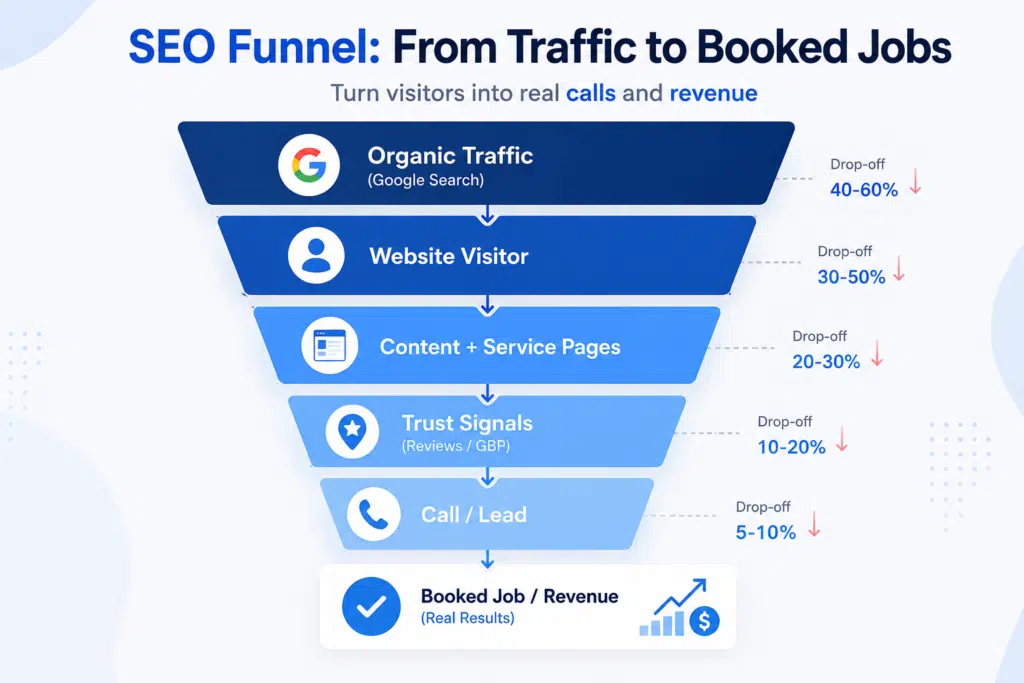
Most restoration companies think SEO is about getting more traffic. That sounds good, but traffic alone does not bring in jobs. We have seen companies ranking for multiple keywords and still struggling to get consistent calls. The problem is not SEO. The problem is the missing SEO funnel.
An SEO funnel is what turns a random website visitor into an actual lead. It connects your content, your service pages, and your local presence into one system that guides people toward contacting you.
For example, someone might land on your water damage guide to understand the issue. But if there is no clear next step, they leave without calling. That is where a proper SEO lead generation funnel changes everything. Instead of hoping users convert, you guide them step by step until they take action.
What Is an SEO Funnel (And Why It Actually Matters)
An SEO funnel is the process of guiding a visitor from their first search to becoming a lead, a call, and eventually a paying customer. It is not just about ranking on Google, it is about turning that visibility into real business results, especially when you understand how Google Search works and how users find information.
In simple terms, an SEO marketing funnel connects your traffic to conversions by giving users the right information at the right stage. A strong SEO conversion funnel makes sure people do not just visit your site, but actually take action.
Here is where most restoration companies go wrong.
They focus on rankings and traffic, but they never build a system behind it. So even when people land on their website, there is no clear next step, no direction, no push toward calling or booking a service.
That is why you often see this pattern:
- High traffic
- Low calls
- No consistent leads
The difference between traffic and revenue is structure. An SEO funnel fixes this by:
- Bringing in the right audience
- Moving them through useful content
- Leading them to service pages
- Turning interest into action
Without a funnel, traffic is just numbers. With a funnel, traffic becomes jobs.
How an SEO Funnel Works for Restoration Companies
An SEO lead generation funnel works differently for restoration companies because not every search follows the same path. Some users are researching while others need help immediately.
Emergency searches (fast decision)
If someone has a flooded basement, they are not reading blogs. They search and call.
Example:
- “emergency water damage near me”
- “24/7 water cleanup”
This is the bottom of the funnel. Your service page, your local profile, and reviews decide if you get the call. That is why pages like water damage leads must focus on action.
Non-emergency searches (longer journey)
Now take mold as an example. A user might search:
- “how long does mold take to grow”
They land on content, then move through your SEO content funnel:
- Blog → awareness
- Service page → trust
- Reviews → confidence
- Call → conversion
How everything connects
A proper funnel connects:
- Blogs
- Service pages
- Google Business Profile
- Calls and forms
If these are disconnected, users drop off. If they are connected, users move naturally toward contacting you.
SEO Funnel Stages (With Real Search Intent)
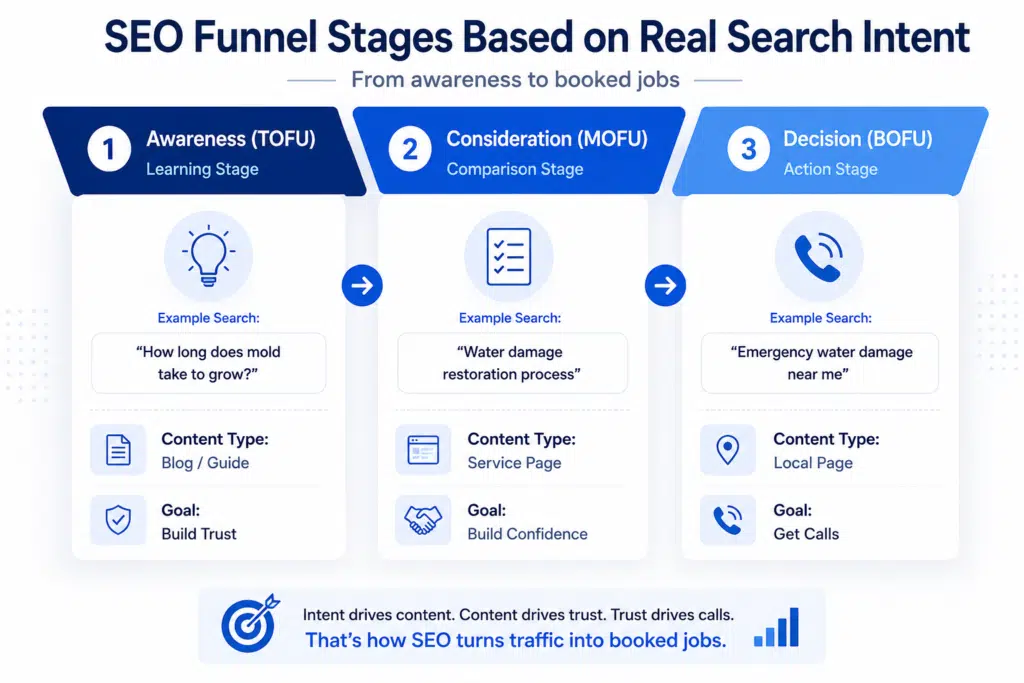
To make an SEO funnel work, you need to understand how people actually search. Not every visitor is ready to call. Some are just learning, some are comparing options, and some need help right now.
That is why strong SEO funnel stages are built around intent, not just keywords. A proper SEO content funnel guides users step by step instead of expecting them to convert on their own.
Here is how the funnel works in a simple and practical way:
| Stage | Search Intent | Example Keyword | Content Type | Goal |
| Awareness (TOFU) | Learning about a problem | how long does mold take to grow | Blog/Guide | Build trust |
| Consideration (MOFU) | Exploring solutions | water damage restoration process | Service/Guide | Build confidence |
| Decision (BOFU) | Ready to hire | emergency water damage near me | Service/Local page | Get calls |
Top of Funnel (Awareness Stage)
At this stage, users are trying to understand the problem. They are not looking for a company yet. Searches like:
- “how long does mold take to grow”
- “signs of water damage in walls”
This is where top of funnel SEO content comes in. Blogs and guides bring in traffic and help users trust your brand early. Content like your water damage guide or restoration industry trends works well here.
Middle of Funnel (Consideration Stage)
Now the user understands the issue and is looking for the right solution. Searches like:
- “water damage restoration process”
- “how to choose a restoration company”
This stage is about trust and clarity. You need to show that you understand the problem and can solve it. Pages like your SEO guide for restoration companies or restoration CRM comparisons help users move closer to a decision.
Not sure which stage your funnel is breaking at.
You’re likely missing key steps that turn traffic into calls.
Bottom of Funnel (Decision Stage)
This is the point where action happens and where the user is ready to call. Searches like:
- “emergency water damage near me”
- “24/7 restoration company”
A strong SEO conversion funnel focuses on removing friction:
- Clear CTAs
- Visible phone numbers
- Strong reviews
Pages like water damage leads and your core lead generation services should be built to convert. If your content does not match intent at each stage, your funnel breaks. When everything connects, traffic turns into calls.
Why Most SEO Funnels Fail (And Where Leads Are Lost)
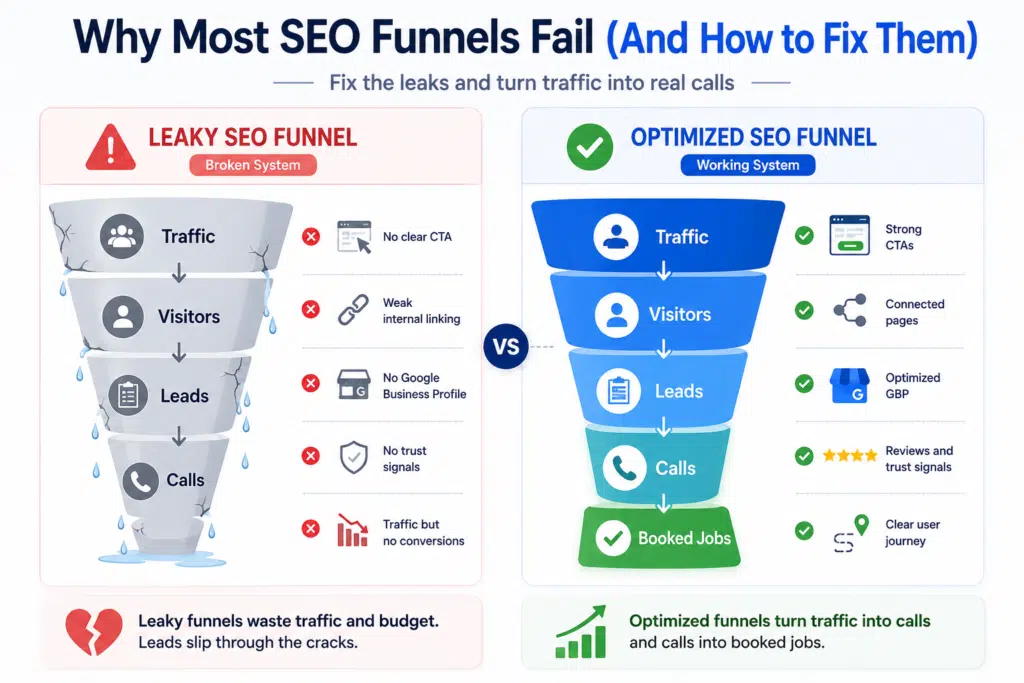
This is something we see all the time. Companies invest in SEO, start getting traffic, and expect leads to follow. But instead, they end up with visitors who never call.
That is not an SEO problem. It is a funnel problem. Without proper SEO funnel optimization, users come in and leave without taking action. The system breaks in between.
Here are the most common leaks we see:
- Traffic but no conversions
Pages bring in visitors, but there is no clear path to contact you. - Weak internal linking
Blogs do not guide users to service pages, so the journey stops early. - No clear CTA
Users do not know what to do next. No visible phone number or strong call to action. - No GBP connection
Users look for local proof and end up calling competitors. - Lack of trust signals
Missing reviews or weak credibility reduces confidence.
When these gaps exist, the funnel leaks at every stage. Fixing this is not about more traffic. It is about building a system where every page moves the user closer to calling you.
One client from the restoration industry shared,
“They’re getting us out of the office and into people’s homes.”
Jesse — Alpha Restoration
That kind of feedback usually comes when the funnel is built correctly. Not just rankings, but content, service pages, local visibility, and conversion elements all working together to generate real leads.
Full-Funnel SEO Strategy That Actually Works in 2026
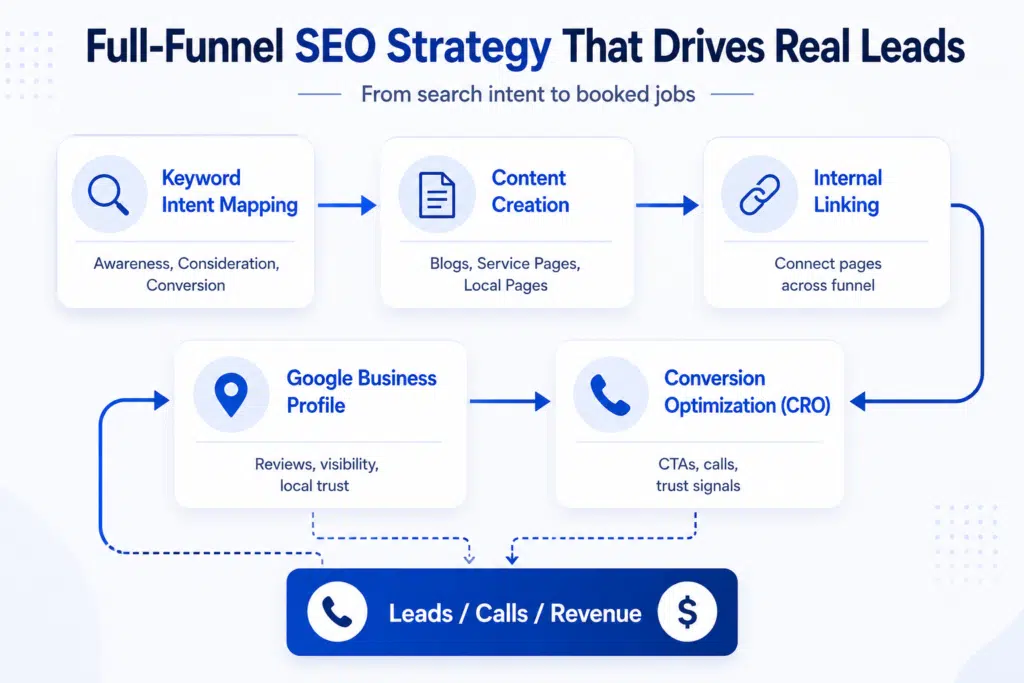
A real full-funnel SEO strategy is not about publishing random blogs or chasing keywords. It is about building a system where every piece of content has a purpose and moves users toward conversion. That is where most strategies fail because they focus on individual tactics instead of how everything connects.
Here is what actually works when you approach SEO funnel optimization the right way:
1. Keyword Intent Mapping
Start by grouping keywords based on intent, not volume.
- Informational keywords for awareness
- Comparison keywords for consideration
- High-intent keywords for conversion
This ensures you are targeting users at every stage instead of only chasing traffic.
2. Content Creation That Matches Intent
Once keywords are mapped, create content that fits each stage:
- Blogs and guides for awareness
- Service and comparison pages for consideration
- Location and service pages for decision
Each page should answer a specific question and guide the user forward.
3. Internal Linking That Moves Users
Content alone is not enough, you need to connect it.
- Link blogs to relevant service pages
- Guide users from awareness to action
- Keep the journey smooth and logical
This is what turns a website into a funnel.
4. Google Business Profile Optimization
For local businesses, this is very important.
- Keep your profile updated
- Add real photos and reviews
- Stay visible in map results
This step often decides who gets the call.
5. Conversion Rate Optimization (CRO)
Even strong traffic will fail without conversion elements.
- Clear CTAs
- Visible phone numbers
- Trust signals like reviews and case studies
Make it easy for users to take action. When you combine all of this, you stop thinking in pages and start thinking in systems. That shift is what turns SEO from a traffic channel into a consistent source of leads and revenue.
Local SEO Funnel: From Google Search to Phone Call
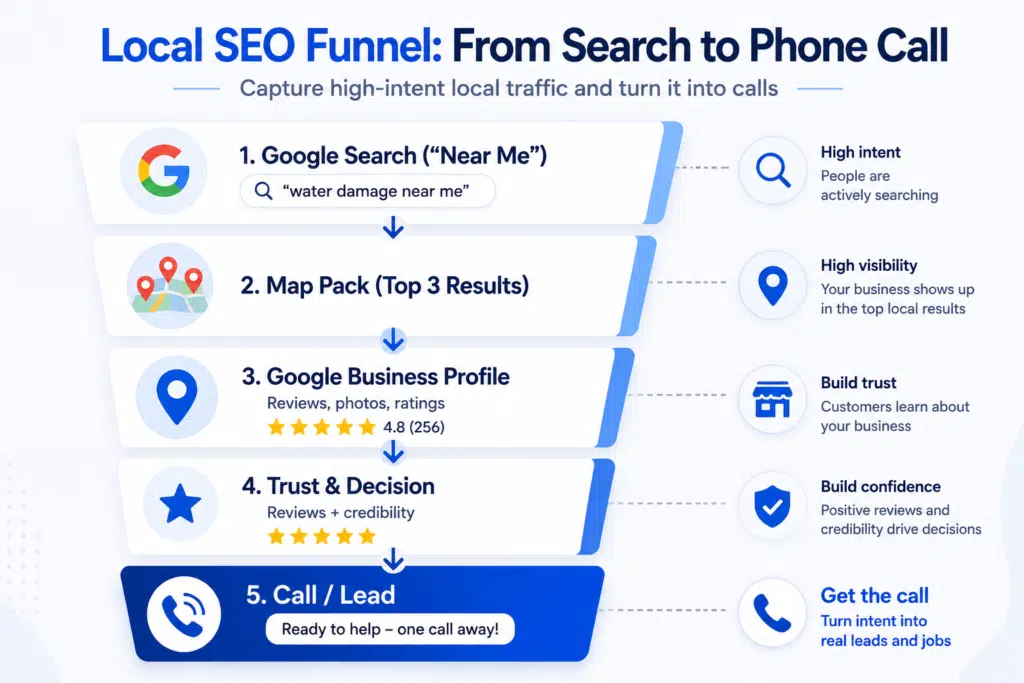
For restoration companies, the local SEO funnel is where most of the real conversions happen. This is not just about ranking in organic results. It is about showing up when someone nearby needs help and is ready to act.
Think about how people actually search.
They type:
- “water damage near me”
- “mold removal company near me”
At this point, they are not reading long blogs. They are looking for a trusted company they can call right away. That is where your GBP and map visibility come in.
Here is how the local funnel works:
- Search → Map Pack → Profile → Call
If you are visible in the map pack with strong reviews, you already have an advantage. If not, that lead goes to someone else.
That trust factor matters more than most companies realize. One client shared,
“We very quickly started getting 3-7 calls a day.”
Daniel Clay — Pure Air North Carolina
Results like this come from a system that connects visibility, trust, and conversion at every stage.
Your Google Business Profile optimization plays a major role here. It helps you show up, build trust, and get clicks. Reviews are just as important. They answer the question users are really asking: “Can I trust this company?”
Local Service Ads also support this funnel by placing you at the top when intent is high. Pages like Google Local Service Ads for restoration leads show how this connects with SEO.
When your local presence is strong, SEO does not just bring traffic, it brings calls.
Ready to turn your SEO into consistent calls?
A proper funnel helps convert traffic into real leads.
SEO Funnel Examples for Restoration Companies
Understanding theory is helpful, but what matters is how an SEO lead generation funnel works in real situations. In restoration, user behavior is not always linear, so your funnel needs to match how people actually search.
Let’s look at two common scenarios.
Example 1: Mold Funnel (Longer Journey)
Mold-related searches usually follow a longer path because users want to understand the problem first.
Blog → Service Page → Trust → Call
A user might search for “how to know if mold is dangerous,” read a guide, and then move to a service page like mold remediation marketing. After that, they check reviews and credibility before deciding to contact the company.
In this case, content plays a bigger role by building trust before conversion.
Example 2: Pure Maintenance Arizona
A strong example of this approach is Pure Maintenance Arizona.
Instead of focusing only on rankings, the strategy was built around connecting content, service pages, and local visibility into one funnel. By targeting high-intent keywords, improving service pages, and strengthening internal linking, their online presence became more consistent and started generating inbound opportunities through search.
You can see the full case study here:
https://restorationinbound.com/pure-maintenance-arizona/
Common Questions About SEO Funnels
What is an SEO funnel in simple terms?
An SEO funnel is a system that turns search traffic into leads and customers. It guides users from learning about a problem to taking action. Instead of just bringing visitors, it helps convert them into calls, inquiries, and booked jobs through structured content and clear next steps.
How is an SEO funnel different from a sales funnel?
An SEO funnel focuses on people already searching for a solution, while a sales funnel often pushes messages to people who may not be ready. With an SEO funnel, users come with intent. That is why conversions are usually higher compared to traditional sales approaches.
How long does it take for an SEO funnel to generate leads?
It depends on competition and your current setup. Some businesses may start seeing early movement in a few months, but consistent leads usually take longer depending on competition and execution. Once it builds momentum, an SEO lead generation funnel can bring steady leads without ongoing ad spend.
Can SEO really generate phone calls for restoration companies?
Yes, and it is one of the most reliable channels. When someone searches for urgent services like water damage or mold removal, they are ready to act. A strong SEO funnel combined with local visibility and trust signals can directly drive phone calls and inquiries.
What is the most important stage of an SEO funnel?
All SEO funnel stages matter, but the decision stage has the biggest impact on revenue. This is where users are ready to contact you. If your service pages, CTAs, or trust signals are weak, you lose the lead even after doing everything right before.
What role does Google Business Profile play in the SEO funnel?
Google Business Profile is critical for local conversions. It helps you show up in “near me” searches and builds trust through reviews and visibility. In many cases, it is the final step before a user decides to call your business.